
Many homeowners install a kitchen chimney expecting it to remove not only smoke and odors but also the heat generated during cooking. While a kitchen chimney can improve the cooking environment, it is important to understand what it is designed to do and what it cannot do.
In this article, we’ll explain whether a kitchen chimney removes heat, how it works, and what you can do to make your kitchen more comfortable during cooking.
What Does a Kitchen Chimney Actually Do?
A kitchen chimney is designed to remove smoke, steam, grease particles, and cooking odors produced while preparing food. It works by drawing in contaminated air through suction and either expelling it outside through a duct or filtering and recirculating it, depending on the chimney type.
Its primary purpose is to improve air quality and keep the kitchen cleaner.
Does a Kitchen Chimney Remove Heat?
A kitchen chimney may help reduce some of the warm air generated during cooking because it removes hot air along with smoke and steam. However, it is not designed to function as a cooling appliance.
The main source of heat in the kitchen remains the gas stove or cooktop, and a chimney alone cannot significantly lower the room temperature.
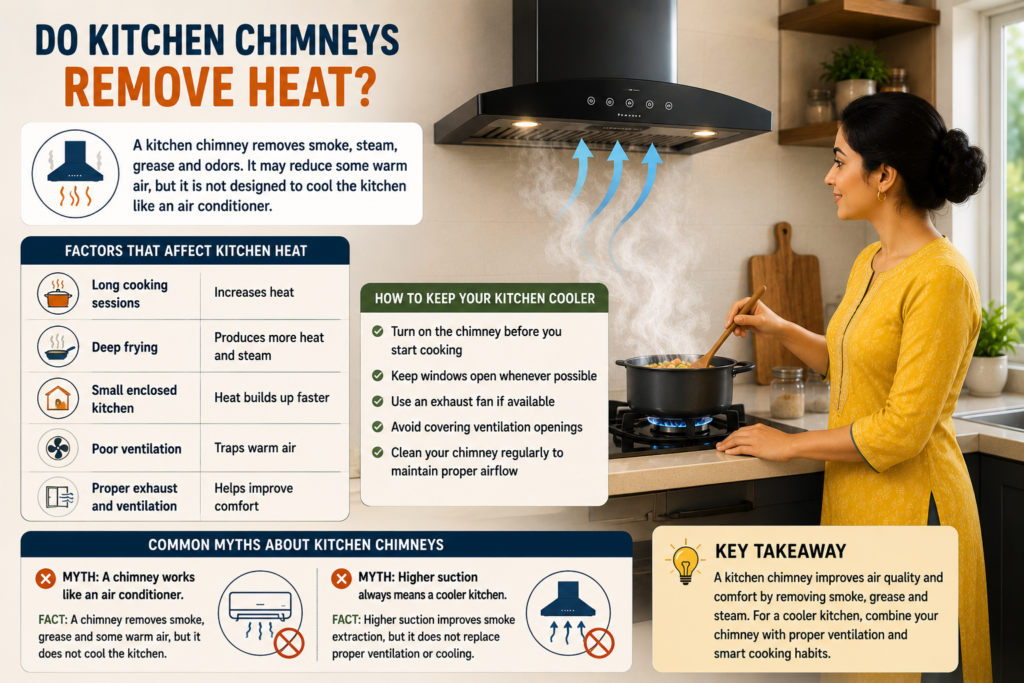
Factors That Affect Kitchen Heat
| Factor | Effect on Kitchen Temperature |
|---|---|
| Long cooking sessions | Increases heat |
| Deep frying | Produces more heat and steam |
| Small enclosed kitchen | Heat builds up faster |
| Poor ventilation | Traps warm air |
| Proper exhaust and ventilation | Helps improve comfort |
How to Keep Your Kitchen Cooler?
- Turn on the chimney before you begin cooking.
- Keep windows open whenever possible.
- Use an exhaust fan if available.
- Avoid covering ventilation openings.
- Clean your chimney regularly to maintain proper airflow.
Common Myths About Kitchen Chimneys
Myth: A chimney works like an air conditioner.
Fact: A chimney removes smoke, grease, and some warm air, but it does not cool the kitchen.
Myth: Higher suction always means a cooler kitchen.
Fact: Higher suction improves smoke extraction, but it does not replace proper ventilation or cooling.
Should You Buy a Chimney If Heat Is Your Main Concern?
If your main concern is reducing smoke, grease, and cooking odors, a kitchen chimney is an excellent investment. However, if your goal is to cool the kitchen, you should also consider proper ventilation, ceiling fans, or other cooling solutions in addition to a chimney.
Conclusion
A kitchen chimney helps create a cleaner and more comfortable cooking environment by removing smoke, grease, steam, and odors. While it may reduce some warm air during cooking, it is not designed to cool the kitchen like an air conditioner.
Understanding its purpose will help you set realistic expectations and choose the right solutions for a healthier kitchen.
Frequently Asked Questions
Can a kitchen chimney cool the kitchen?
No. A kitchen chimney is designed to remove smoke, grease, steam, and odors. It is not a cooling appliance.
Why does my kitchen still feel hot after installing a chimney?
Cooking appliances continue to generate heat. While the chimney removes some warm air, additional ventilation may be needed to improve comfort.
Does higher suction reduce kitchen heat?
Higher suction can improve smoke extraction, but it does not significantly reduce the overall temperature of the kitchen.
To understand how chimney performance depends on airflow, read our guide on How Much Suction Power is Required for an Indian Kitchen?
You may also like our article How High Should a Kitchen Chimney Be Installed? to learn how proper installation affects performance.