
Have you ever wondered what actually happens inside your kitchen chimney when you switch it on and start cooking?
You see the smoke disappearing, but where does it go?
How does the chimney capture oily vapours? What happens to the grease? What role do the filters, blower, motor, and duct play?
A kitchen chimney is actually a carefully designed airflow system. Several components work together within seconds of switching it on.
Let’s take a look at what happens inside a kitchen chimney while you cook, step by step.
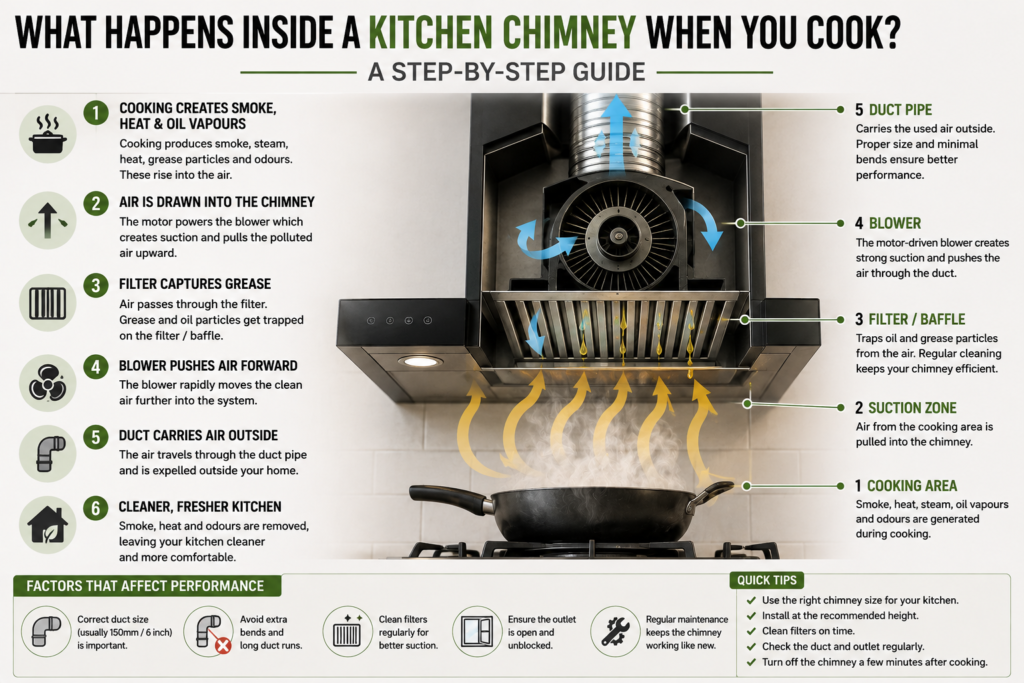
Step 1: Cooking Creates Smoke, Heat, Steam and Oil Vapours
When you fry, sauté, grill, or prepare food using oil and spices, cooking releases more than just visible smoke.
The cooking process can produce:
- Smoke
- Steam
- Heat
- Oil vapours
- Grease particles
- Cooking odours
- Fine airborne particles
Without proper ventilation, these particles can spread throughout the kitchen and settle on walls, cabinets, ceilings, and other surfaces.
This is where the kitchen chimney comes into action.
Step 2: The Chimney Creates Airflow
When you switch on your chimney, the motor starts driving the blower.
The blower creates a pressure difference that pulls air upward from the cooking area.
You may not be able to see this airflow, but it is continuously drawing cooking vapours toward the chimney.
This is why positioning the chimney correctly above the cooking surface is so important.
Step 3: Smoke and Oil Vapours Enter the Chimney
As hot air rises from your cooking surface, the chimney captures a significant portion of the smoke, grease-laden air, and cooking vapours.
The efficiency of this process depends on several factors, including:
- Chimney design
- Suction capacity
- Chimney size
- Distance from the cooking surface
- Filter condition
- Duct design
- Cooking method
A chimney that is incorrectly installed or poorly maintained may not capture cooking vapours effectively.
Step 4: The Filter Deals With Grease
This is one of the most interesting parts of the process.
The air entering the chimney can contain tiny oil and grease particles.
Depending on the chimney design, these particles interact with the filter.
For example, a baffle filter is designed to change the direction of airflow, helping grease separate from the air and collect on the filter or in the oil collection system.
Other chimney designs may use different filtration technologies.
This is one reason why filters need regular cleaning or replacement according to the chimney manufacturer’s recommendations.
Step 5: The Blower Moves the Air
After passing through the relevant filtration stage, the airflow reaches the blower.
The blower is one of the key components responsible for moving air through the chimney system.
The motor powers the blower and helps push the extracted air toward the duct.
If the motor or blower develops a problem, the chimney may become noisy, slow, or less effective.
Step 6: The Duct Carries the Air Outside
In a ducted chimney, the extracted air travels through the duct pipe and is discharged outside the building.
Think of the duct as the chimney’s pathway to the outside.
This is why duct design matters.
A poorly planned duct with excessive bends, restrictions, or blockages can increase airflow resistance and affect the chimney’s performance.
Step 7: Grease Doesn’t Simply Disappear
One common misconception is that the chimney “removes” all the grease permanently.
That’s not quite how it works.
Some grease particles are captured by the filtration system, which means grease gradually accumulates on the filter and other areas.
Over time, this buildup can become significant.
That’s why a chimney that was performing perfectly when new may eventually show reduced performance if it isn’t maintained properly.
Step 8: The Kitchen Becomes Cleaner
When the chimney is correctly installed and operated, it captures and exhausts a substantial amount of cooking vapour before it spreads around the kitchen.
This can help reduce:
- Greasy kitchen surfaces
- Lingering cooking odours
- Smoke accumulation
- Deposits on cabinets
- Cleaning effort
However, a chimney is not a substitute for general kitchen ventilation and proper cooking practices.
What Happens If the Filter Is Dirty?
Now imagine the same process—but with a heavily clogged filter.
Air has to pass through a restricted pathway.
This can affect the chimney’s airflow and may contribute to:
- Reduced suction
- Increased noise
- Poor smoke removal
- Greater grease accumulation
- Increased stress on components
This is why cleaning and maintaining the filtration system is so important.
What Happens If the Duct Is Blocked?
A blocked or severely restricted duct can create another problem.
The chimney may still turn on, and you may hear the motor running, but the extracted air cannot move outside efficiently.
As a result, smoke and cooking odours may remain in the kitchen.
So when a chimney appears to have “weak suction”, the motor isn’t necessarily the only thing that should be checked.
The filter, duct, blower, and installation should also be inspected.
What Happens When You Switch the Chimney Off?
When you switch the chimney off, the motor and blower stop operating.
The forced airflow stops, although normal air movement in the kitchen continues naturally.
Many homeowners allow the chimney to run for a few minutes after cooking to help remove remaining vapours and odours.
Always follow the operating recommendations provided with your specific chimney.
Why Does Your Chimney Get Dirty Even Though It Is Removing Smoke?
This is actually a sign that the chimney is doing an important part of its job.
The cooking process releases grease and oil vapours.
Some of those particles are captured by the chimney’s filtration system instead of settling throughout your kitchen.
The result?
The chimney itself becomes dirty.
That’s why a dirty filter doesn’t necessarily mean the chimney isn’t working. It means the filter needs appropriate cleaning or replacement.
The Complete Journey of Cooking Smoke
The entire process can be simplified like this:
Cooking → Smoke & Oil Vapours → Chimney Intake → Filter → Blower → Duct → Outside
Each stage matters.
If one part of the system isn’t working correctly, the overall performance of the chimney can be affected.
How Can You Help Your Chimney Work Better?
A few simple habits can make a significant difference:
Keep the filters clean
Follow the manufacturer’s recommended cleaning schedule.
Use the correct chimney size
The chimney should be appropriately sized for your cooking area and cooktop.
Keep the duct properly installed
Avoid unnecessary bends and restrictions.
Don’t ignore unusual noises
A sudden change in sound can indicate that inspection is needed.
Keep the chimney at the recommended installation height
Incorrect positioning can affect smoke capture.
Don’t ignore reduced suction
If the chimney suddenly performs differently, investigate the cause rather than simply increasing the speed.
Final Thoughts
A kitchen chimney is much more than a fan hanging above your stove.
When you start cooking, a complete process begins: airflow is created, cooking vapours are captured, grease is filtered, air is moved by the blower, and in a ducted system, the extracted air is carried outside.
Understanding this process also explains why filters, motors, blowers, ducts, installation height, and regular maintenance all matter.
The next time you switch on your kitchen chimney, remember that several components are working together to keep your kitchen cleaner and more comfortable.
Frequently Asked Questions
Does a kitchen chimney remove all cooking smoke?
A properly installed and maintained chimney can capture and exhaust a significant amount of cooking smoke and vapours, but no chimney can guarantee removal of every particle.
Why does grease collect inside a chimney?
Cooking produces oil and grease particles. The chimney’s filtration system captures some of these particles, which gradually accumulate on filters and other components.
Does a powerful motor always mean better chimney performance?
Not necessarily. Overall performance also depends on the filter, blower, duct design, installation, chimney placement, and maintenance.
Why is my chimney running but not removing smoke?
Possible causes include dirty filters, duct restrictions, incorrect installation, blower problems, motor issues, or insufficient airflow. The complete system should be checked.
If you want to learn more about kitchen chimney performance, installation and maintenance, read these related guides:
- Why Is My Kitchen Chimney Not Removing Smoke Properly? Causes and Solutions
- How Much Suction Power Is Required for an Indian Kitchen?